
One Confession Away: Scrupulosity or Religious OCD
One Confession Away: What the Church Called Faithfulness and What It Actually Was

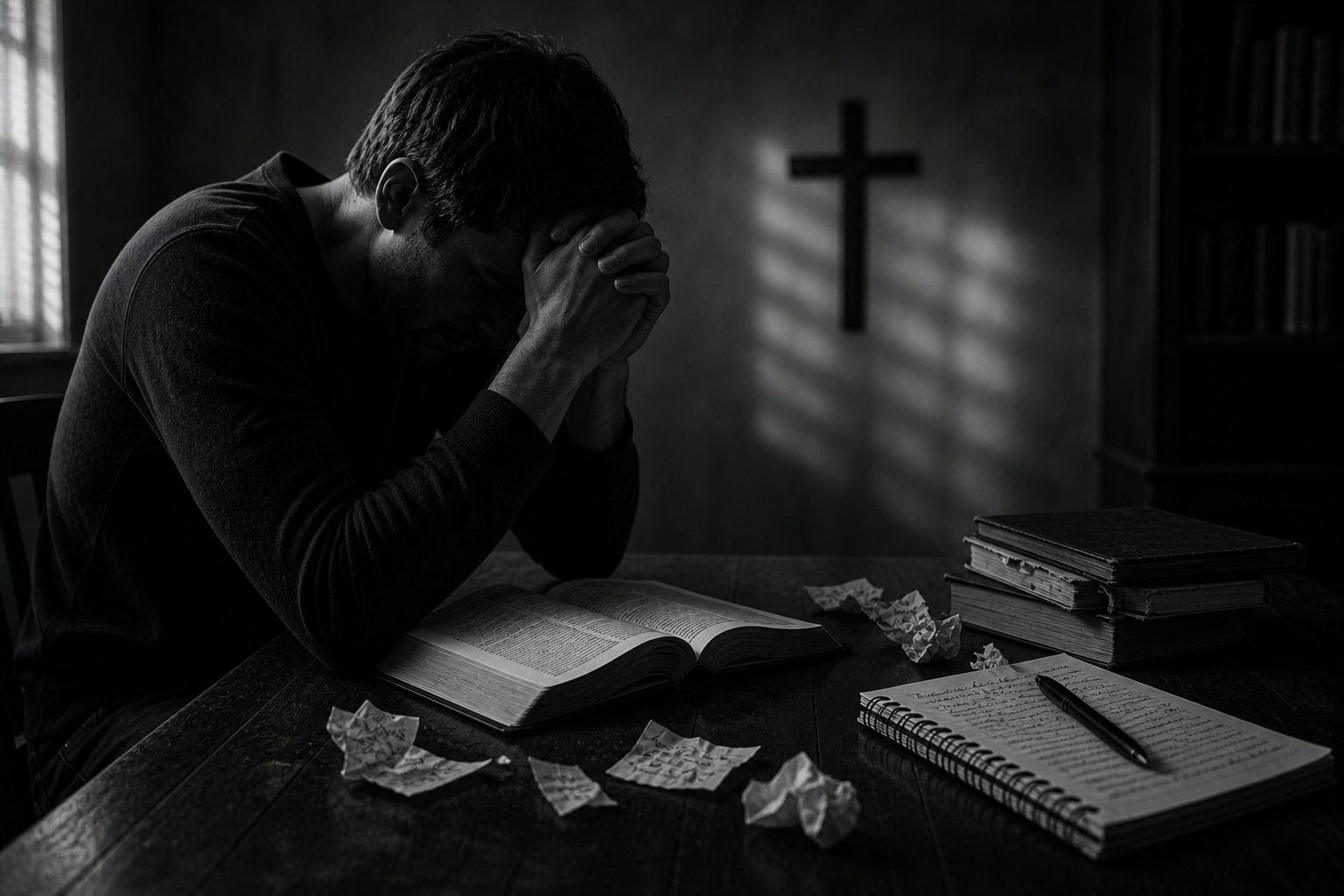
For years I lived with a terror that arrived without warning and left only when I had done something to satisfy it. The something was never quite enough. The terror always came back.
It worked like this. A thought would arrive — unwanted, unbidden, attached to shame before I had time to evaluate it. In the framework I had been given, that meant it was from God. The Holy Spirit convicted. The Holy Spirit pressed on the conscience, created discomfort, drew attention to sin. Intrusive thoughts did exactly the same thing. I had no framework for making the distinction, and the theology I had been raised in made the question almost impossible to resolve. So I did what felt safe. I attributed all of it to God.
Every disturbing image. Every unwanted thought about sex or violence or doubt. Every moment of sudden guilt with no clear origin. I treated it as divine communication and responded accordingly.
I confessed things I hadn’t done. I repented of thoughts I hadn’t chosen. I carried the weight of a spiritual life that was being generated, in significant part, by a neurological condition I didn’t know I had.
One of the worst periods centered on a verse from Matthew. If your eye causes you to sin, pluck it out. I was struggling with what I understood as sexual fixation — intrusive thoughts with sexual content that arrived without invitation and attached immediately to shame. The verse landed as a divine instruction. Not metaphor. Literal communication from God about what he required. And alongside it came the thought that if I would only utterly humiliate myself — public confession, complete exposure, total surrender of whatever pride was left — God would finally give me relief.
I went years believing the relief was one step away. One confession away. One act of complete humiliation away. I just had to be willing.
The relief never came. The thought always returned. And I had no name for what was happening to me.
The clinical name for it is scrupulosity.
Scrupulosity is a recognized subtype of Obsessive-Compulsive Disorder in which the obsessions and compulsions center on religious or moral themes. The intrusive thoughts attach to whatever the sufferer holds most sacred. In a religious context that means sin, damnation, spiritual purity, and the will of God. The compulsions that follow — confession, prayer, repentance, reassurance-seeking — are attempts to neutralize the anxiety those thoughts produce. The relief is temporary. The thoughts return. The cycle continues.
This is not a fringe diagnosis or a newly invented category. It is well documented, well researched, and recognized by every major clinical body that works with OCD. It is also almost never talked about openly, particularly in religious communities and particularly among men, because the specific content of the obsessions — religious failure, sexual sin, moral contamination — carries so much shame that sufferers rarely name it even to themselves.
What the research shows about scrupulosity is unambiguous on one point. Fear-based religious environments make it significantly worse. Environments that use the threat of hell, divine judgment, and spiritual contamination as primary motivators take an existing clinical condition and turn the volume up until it is unbearable. The conditioned hypervigilance that high-control religion produces in all its members produces something closer to psychological crisis in those with OCD. The system doesn’t create the condition. But it finds the condition and amplifies it into something that can consume a person’s entire inner life.
There is a particular cruelty in how this plays out inside communities like the one I grew up in. Scrupulous compulsions — excessive prayer, repeated confession, exact and anxious obedience, relentless self-examination for evidence of sin — are not recognized as symptoms in that environment. They are praised as signs of spiritual seriousness. The person suffering most acutely from religious OCD looks, from the outside, like the most faithful person in the room. Their torment is invisible. Their compulsions are affirmed. And when the suffering finally becomes too great to hide, it gets reframed as spiritual weakness, insufficient faith, a character defect requiring more repentance.
More repentance is precisely the thing that makes scrupulosity worse.
Nobody noticed.
I want to sit with that for a moment because I think it is important. I was not subtle about my spiritual anxiety. I was visibly, intensely serious about my faith in ways that went beyond what most of my peers demonstrated. I examined myself constantly. I confessed frequently. I carried a weight that was apparent to anyone who spent time around me.
No one ever suggested that what I was experiencing might be something other than spiritual struggle. No minister, no parent, no peer ever said — that level of anxiety, that relentlessness, that inability to find peace after confession — that might be something we should look at more carefully.
They didn’t say it because they didn’t have the framework to say it. The community I grew up in had a complete and confident explanation for what I was experiencing. I was self-willed. I was not fully surrendered. The peace I couldn’t find was evidence of the repentance I hadn’t completed. The framework explained the suffering in a way that felt coherent and left no room for any other interpretation.
So I carried it alone. For years.
What made it harder was that I was also carrying a different label entirely.
For approximately ten years, my mother told me I was bipolar. She was not a clinician. She was a woman with a framework of her own and a son whose emotional experience she was trying to account for. I don’t say that with anger — I think she was doing what she understood to do. But the effect was that I spent roughly a decade with a diagnostic label that didn’t fit, taking medications I likely shouldn’t have been taking, and carrying the shame of a condition I didn’t actually have.
Bipolar disorder carries its own weight in a religious community. It suggests instability. It suggests that what you feel cannot be trusted. It suggests that the highs and lows of your emotional life are symptoms of a broken brain rather than responses to real circumstances. I internalized that. I added it to everything else I was already carrying.
What I didn’t know — what I had no way of knowing — was that the misdiagnosis and the unrecognized scrupulosity were operating simultaneously. Two wrong explanations for the same suffering. Neither one touching what was actually happening.
I knew the term religious OCD for years before I applied it to myself.
That gap deserves some attention because I don’t think it was accidental. I read about it. I understood it as a category. And I kept placing it somewhere slightly outside my own experience — more severe cases, more obvious presentations, people whose symptoms were clearer than mine. I was not doing this consciously. I was doing what the system I had been raised in trained me to do, which was to be the last person to trust my own interpretation of my own experience.
The shift came recently, and it came sideways. I had begun to think that a few of my symptoms might fall loosely under OCD as a general category. Not a complete explanation — just a partial overlap. I started asking questions about that overlap and someone handed me the word scrupulosity.
I pulled one thread and the whole thing came with it.
That experience — of expecting a partial match and finding a complete one, of reaching for a small explanation and getting the large one instead — is difficult to describe. It is disorienting and relieving in the same moment. You are glad to finally have the right name. You are also sitting with the knowledge of how long you went without it, and what that cost.
I am writing this for the person who is where I was.
You do not have to have a formal diagnosis. You do not have to be certain. But if you have spent years believing that the relief is one confession away, that God is asking for one more act of humiliation before he gives you peace, that the thoughts arriving with shame are divine communication requiring a response — I want you to know that there is a clinical framework for what you are experiencing, it has nothing to do with the depth of your repentance, and it is treatable.
The community that shaped you may have praised your suffering as faithfulness. It may have had no language for what was actually happening inside you. It may have taken a neurological condition and handed it a theological explanation and called that pastoral care.
That explanation was wrong. And you do not have to keep living inside it.
The word is scrupulosity. Look it up. See if it fits.
For a lot of people reading this, I suspect it will fit more than you expected.
I've learned a new word today. Thank you. From other comments, it seems this has found its audience, and I suspect there will be others. Keep writing, you're doing good work.
Thank you for posting! I was just diagnosed with OCD and struggled too long with moral scrupulosity. More people need to hear about it. Subbed 👋